
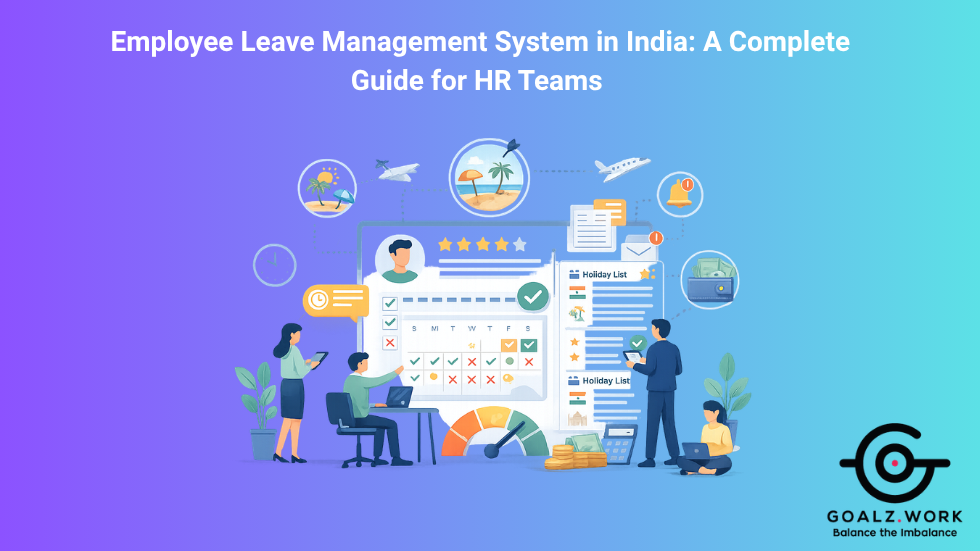
Managing employee leave has become one of the most time-consuming HR responsibilities for Indian businesses. Growing teams, diverse leave policies, state-specific labor laws, and hybrid work arrangements leave little room for manual tracking. Even a small error in leave records can trigger payroll disputes, compliance violations, and frustrated employees.
At Goalz.Work, we work with Indian organizations that face daily challenges around leave management — from incorrect leave balances to delayed approvals and payroll mismatches. The root cause is almost always the same: outdated, manual leave management processes that cannot scale with business growth.
This guide explains what an employee leave management system is, how it works in India, its key features, benefits, compliance requirements, and how businesses can choose the right solution to manage leave efficiently and confidently.
What Is an Employee Leave Management System?
An employee leave management system is a digital platform that automates the entire process of applying for, approving, tracking, and reporting employee leaves. It covers all leave types — casual leave, sick leave, earned leave, maternity leave, paternity leave, compensatory leave, and more.
In India, leave management is deeply connected to payroll processing and statutory compliance. Leave balances affect salary calculations. Leave policies must align with the Factories Act, Shops and Establishment Acts, and other state-specific labor regulations. When this process depends on spreadsheets or email chains, errors become inevitable and costly.
Leave management software replaces these fragmented systems with a centralized platform that records leave data accurately, automates workflows, and keeps HR teams in control at all times.
Why Leave Management Matters More in India
Indian organizations operate under a complex web of central and state labor laws. Leave entitlements vary across industries, employee categories, and locations. A factory worker in Maharashtra has different statutory leave rights than an IT employee in Bengaluru. Managing this diversity manually is both risky and inefficient.
Poor leave management creates a cascade of problems: payroll errors, employee dissatisfaction, compliance penalties, and an excessive HR workload. When employees cannot check their leave balance easily or when approvals take days, trust erodes and productivity suffers.
A structured leave management system helps Indian businesses stay legally compliant, process payroll accurately, and give employees the transparent, self-service experience they expect in 2026.
How an Employee Leave Management System Works
A leave management system acts as the single source of truth for all employee leave data across the organization. The process is simple and automated from start to finish.
Employees submit leave requests through a self-service portal or mobile app. Managers receive instant notifications and approve or reject requests with a single click. Leave balances update automatically. Payroll systems sync with the latest leave data to ensure accurate salary calculations.
HR teams gain real-time visibility into team availability, leave trends, and compliance status — without chasing emails or manually updating spreadsheets.
At Goalz.Work, the leave management module is built to handle this entire lifecycle seamlessly, from policy configuration to payroll integration.
Core Components of a Leave Management System
| Component | Purpose |
|---|---|
| Employee Self-Service Portal | Employees apply, track, and cancel leave requests independently |
| Manager Approval Workflow | Requests follow defined approval chains automatically |
| Leave Policy Configuration | HR configures leave types, accrual rules, and carry-forward policies |
| Leave Balance Tracking | Real-time visibility into available, used, and lapsed leave |
| Payroll Integration | Leave data syncs directly with salary calculations |
| Compliance Reports | Audit-ready records aligned with Indian labor laws |
| Analytics Dashboard | Trends, patterns, and workforce availability insights |
This structure reduces errors, improves transparency, and keeps HR teams focused on people rather than paperwork.
Key Features of a Leave Management System in India
An effective leave management system must support both HR efficiency and legal compliance across India’s diverse regulatory landscape.
1. Configurable Leave Policies
No two organizations in India have identical leave policies. A leave management system must allow HR teams to configure multiple leave types — earned leave, casual leave, sick leave, privilege leave, compensatory off, and statutory leaves like maternity and paternity leave.
Goalz.Work supports fully customizable leave policies, including accrual schedules, encashment rules, carry-forward limits, and probation period restrictions.
2. Employee Self-Service Portal
When employees can check leave balances, apply for leave, and track approval status on their own, HR query volumes drop significantly. A self-service portal empowers employees with transparency while reducing the administrative burden on HR teams.
Mobile accessibility is equally important. Employees working remotely or on-site should be able to manage leave from their phones without needing to access a desktop system.
3. Multi-Level Approval Workflows
Leave approval processes vary by organization. Some require only manager approval. Others involve HR verification or department head sign-off. A leave management system must support configurable multi-level approval workflows that reflect the actual organizational hierarchy.
Automated notifications at each step ensure requests do not get lost or delayed in an inbox.
4. Leave Balance and Accrual Management
Accurate leave balance tracking is the foundation of fair leave management. The system must automatically calculate accruals based on policy rules, update balances when leaves are approved or cancelled, and handle edge cases like leave encashment, lapsing, and carry-forward at year-end.
Manual balance management is one of the most error-prone HR tasks. Automating it eliminates discrepancies and gives employees confidence in the accuracy of their records.
5. Payroll Integration
Leave data and payroll are inseparable. Unpaid leave, leave encashment, and loss of pay calculations must flow seamlessly from the leave management system into payroll processing. Without tight integration, payroll teams spend hours reconciling discrepancies — a process prone to errors and delays.
At Goalz.Work, leave and payroll data are managed on a connected platform, ensuring every salary calculation reflects accurate, real-time leave information.
6. Statutory and Compliance Support
India’s labor laws mandate specific leave entitlements that organizations must honor. The Factories Act requires earned leave of one day for every twenty days worked. Maternity leave entitlements under the Maternity Benefit Act 2017 extend to twenty-six weeks for eligible employees. State-specific Shops and Establishment Acts add further variation.
A leave management system built for India must support statutory leave configuration, maintain digital compliance records, and generate audit-ready reports that protect organizations during inspections.
7. Holiday Calendar Management
National holidays, regional public holidays, and optional holidays vary across states and offices. A leave management system should support location-wise holiday calendars that automatically apply the correct holidays for employees based on their work location.
This prevents situations where employees in different cities apply for the same day — one as a public holiday, another as regular leave.
Leave Management vs Manual Tracking
Many Indian organizations still rely on email, spreadsheets, or paper forms. The difference becomes painfully clear as teams grow beyond a handful of employees.
| Aspect | Manual Tracking | Leave Management System |
|---|---|---|
| Leave Application | Email or paper form | Digital self-service portal |
| Approval Speed | Days or weeks | Minutes with automated workflows |
| Balance Accuracy | High risk of errors | Real-time automated calculations |
| Payroll Impact | Frequent mismatches | Seamless payroll sync |
| Compliance | Difficult to maintain | Built-in statutory support |
| HR Workload | High and repetitive | Automated and efficient |
| Employee Experience | Frustrating and opaque | Transparent and self-managed |
Scaling a business on manual leave tracking is not just inefficient — it is a liability.
Benefits of a Leave Management System
For HR Teams
HR teams regain hours previously spent answering leave balance queries, chasing approvals, and manually updating records. Automated workflows handle the routine. HR professionals can focus on strategic priorities like talent development, workforce planning, and employee engagement.
For Managers
Managers gain instant visibility into team availability. When an employee applies for leave, managers see current team schedules and can make informed approval decisions. This prevents situations where multiple team members are absent simultaneously, protecting project continuity.
For Employees
Employees benefit most from transparency and speed. Clear leave balances, fast approvals, and the ability to manage leave from a mobile device significantly improve the employee experience. This reduces frustration, builds trust in HR processes, and contributes to overall job satisfaction.
For Business Operations
Accurate leave data feeds directly into payroll, workforce scheduling, and headcount planning. Organizations avoid payroll errors, reduce compliance risks, and maintain operational continuity even during peak leave seasons. The business impact of getting leave management right is both immediate and compounding.
Leave Management and Labor Law Compliance in India
Compliance is non-negotiable for Indian organizations. Failing to honor statutory leave entitlements exposes businesses to penalties, employee grievances, and reputational damage during audits or labor inspections.
Key statutory leave obligations in India include earned leave under the Factories Act and various state Shops and Establishment Acts, maternity leave under the Maternity Benefit Act 2017, paternity leave as per company policy and applicable regulations, and public holiday observance under applicable state laws.
A leave management system designed for India maintains digital attendance and leave records, generates statutory compliance reports, and creates an audit trail that covers the organization at every stage of a regulatory review.
Managing Leave Trends and Workforce Planning
Beyond individual approvals, leave management data provides valuable workforce planning intelligence. HR teams can analyze patterns — which departments experience the highest absenteeism, which months see peak leave demand, and whether certain teams are consistently understaffed during critical periods.
This data enables proactive planning. HR and operations leaders can adjust staffing levels in advance, manage project timelines around anticipated leave peaks, and identify potential burnout signals in teams with unusually low leave utilization.
Data-driven leave management transforms what was previously a reactive administrative task into a strategic workforce planning tool.
Leave Management for Remote and Hybrid Teams
Remote and hybrid work introduced new complexity into leave management. When employees work across time zones or flexible schedules, tracking leave accurately requires more than a physical attendance register.
Cloud-based leave management software resolves this entirely. Remote employees apply for leave through a mobile app or web portal. Managers approve requests from anywhere. HR teams maintain complete visibility across distributed workforces without depending on location-based processes.
Goalz.Work’s leave management module supports remote and hybrid teams natively, ensuring consistent leave policies and accurate records regardless of where employees work.
Integration with Attendance and Payroll Systems
Leave management does not operate in isolation. It must connect seamlessly with attendance tracking and payroll systems to deliver accurate results.
Attendance integration ensures that unauthorized absences are flagged and reflected correctly in leave records. Payroll integration ensures that approved leaves, loss of pay deductions, and encashment calculations flow accurately into every salary run. HRMS integration keeps employee data consistent across all HR functions.
At Goalz.Work, integration is built into the platform from the ground up. Leave, attendance, performance, and payroll data share a unified data layer — eliminating reconciliation errors and reducing administrative overhead across the entire HR function.
Pricing of Leave Management Software in India
Pricing for leave management software varies based on features, employee count, and integration depth.
| Pricing Model | Description |
|---|---|
| Per Employee Per Month | Scalable pricing that grows with headcount |
| Tiered Plans | Starter, Professional, and Enterprise packages |
| Bundled HRMS Platforms | Combined leave, attendance, and payroll solutions |
| Custom Enterprise Pricing | Tailored for large or multi-location organizations |
For growing Indian businesses, bundled HRMS platforms that include leave management alongside attendance tracking and payroll integration often deliver the best value. Standalone tools may be cheaper upfront but create integration challenges that increase total cost over time.
How to Choose the Best Leave Management System
Selecting the right leave management system depends on your organization’s size, structure, and compliance requirements.
Map your leave policies first. Understand how many leave types you need to configure, what your accrual rules are, and which statutory obligations apply to your workforce. A system that cannot handle policy complexity will create more problems than it solves.
Prioritize ease of use. A system your employees and managers actually use is infinitely more valuable than one with advanced features that go ignored. Look for intuitive interfaces, mobile accessibility, and minimal training requirements.
Verify compliance coverage. Ensure the platform supports Indian statutory leave types and generates the compliance reports your organization needs for audits and regulatory submissions.
Assess integration capabilities. Your leave management system must talk to your attendance and payroll systems. Siloed tools create data inconsistencies that undermine the accuracy of your entire HR operation.
Plan for growth. Choose a platform that scales with your business — one that accommodates new locations, employee categories, and policy structures without requiring a system replacement as you grow.
Why Goalz.Work for Leave Management
At Goalz.Work, we build leave management solutions for Indian businesses that need more than a basic approval workflow. Our platform supports the full leave lifecycle — from policy configuration and self-service applications to compliance reporting and payroll integration — in one unified system.
We help HR teams eliminate manual processes, give employees transparent self-service access, and ensure every leave decision is backed by accurate data. Our approach is designed for the complexity of Indian labor law, the diversity of Indian workforces, and the pace of modern business.
Whether you are a startup formalizing leave policies for the first time or an enterprise modernizing fragmented leave systems across multiple locations, Goalz.Work gives you the tools to manage leave with confidence.
Conclusion
An employee leave management system is no longer optional for Indian organizations that want to operate efficiently and stay compliant. Manual tracking increases errors, creates payroll risks, and burdens HR teams with repetitive administrative work that adds no strategic value.
At Goalz.Work, we help businesses manage employee leave accurately, stay aligned with Indian labor laws, and create a seamless experience for employees and managers alike. The right leave management system does not just automate a process — it builds a foundation of trust, transparency, and operational excellence across the entire organization.
Investing in a leave management system today means fewer errors tomorrow, stronger compliance always, and an employee experience that reflects the standard your people deserve.
Simplify Leave Management Across Your Entire Organization
Configure policies, automate approvals, and keep payroll accurate — all in one platform built for Indian businesses.
Frequently Asked Questions
1. What is an employee leave management system?
An employee leave management system is a digital platform that automates leave applications, approvals, balance tracking, and compliance reporting. It replaces manual processes with an integrated system that connects leave data with payroll and attendance management.
2. Why do Indian businesses need a leave management system?
India’s labor laws mandate specific leave entitlements that vary by state, industry, and employee category. A leave management system ensures statutory compliance, reduces payroll errors caused by incorrect leave data, and gives HR teams real-time visibility into workforce availability.
3. What types of leave can be managed in a leave management system?
A comprehensive system supports casual leave, sick leave, earned or privilege leave, maternity and paternity leave, compensatory off, optional holidays, and any custom leave types defined in your company policy. Statutory leave types are configured to meet legal requirements automatically.
4. How does a leave management system integrate with payroll?
Leave balances and approved leaves sync directly with payroll calculations. Loss of pay deductions, leave encashment amounts, and absence-related adjustments flow automatically from the leave management system into salary processing — eliminating manual reconciliation and reducing payroll errors.
5. How much does leave management software cost in India?
Pricing typically follows a per-employee-per-month model, with costs varying based on features, integrations, and organization size. Bundled HRMS platforms that combine leave management with attendance and payroll processing generally deliver better cost efficiency for growing businesses compared to standalone tools.
Recent Comments