
In the fast-evolving landscape of 2025, where artificial intelligence (AI) is reshaping job roles, hybrid work models are the norm, and the global talent shortage looms large, organizations can’t afford to treat workforce planning as an afterthought. According to the World Economic Forum’s Future of Jobs Report 2025, technological innovation and the green transition will disrupt 85 million jobs while creating 97 million new ones, demanding unprecedented agility from HR leaders. Yet, a McKinsey HR Monitor 2025 survey reveals that only 40% of companies approach workforce planning strategically, leaving many vulnerable to skills gaps and talent mismatches.
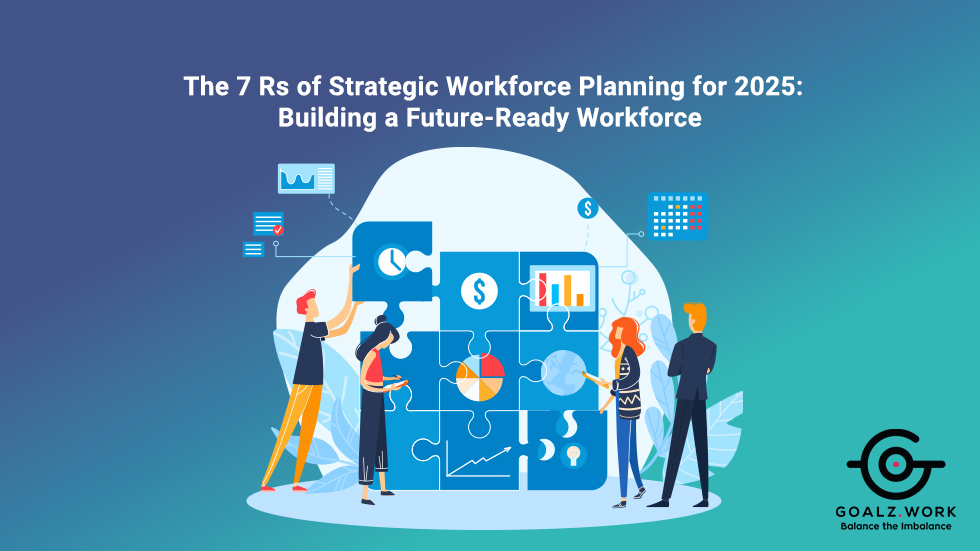
Enter Strategic Workforce Planning (SWP)—a proactive methodology that aligns human capital with business objectives, ensuring organizations not only survive but thrive amid uncertainty. At the heart of effective SWP lies the “7 Rs” framework: the Right People, Right Skills, Right Shape, Right Size, Right Time, Right Place, and Right Cost. This time-tested model, popularized in HR circles, provides a roadmap for building resilient teams that can navigate AI-driven automation, remote collaboration, and sustainability imperatives.
In this blog, we’ll dive deep into each of the 7 Rs, exploring their definitions, practical applications, and tailored strategies for 2025. Drawing on insights from industry experts and recent trends, we’ll uncover how these principles can transform your workforce into a competitive advantage. Whether you’re an HR executive plotting the next fiscal year or a C-suite leader eyeing long-term growth, mastering the 7 Rs will equip you to future-proof your organization. Let’s get started.
Understanding Strategic Workforce Planning: The Foundation for 2025 Success
Strategic Workforce Planning isn’t just about filling seats—it’s a systematic process to forecast, develop, and deploy talent in harmony with your company’s vision. Unlike traditional HR planning, which reacts to immediate needs, SWP takes a forward-looking stance, typically spanning three to five years, to anticipate disruptions and seize opportunities. In 2025, with Gartner identifying strategic workforce planning as a top HR priority alongside leader development and organizational culture, this approach is non-negotiable for staying ahead.
The SWP process unfolds in four core steps, rooted in organizational strategy and market analysis:
- Assess the Current State: Begin with a deep dive into your existing workforce. Use tools like the 9-box grid for performance-potential mapping and personnel flow matrices to track inflows (hires), outflows (turnover), and internal movements (promotions). This reveals quantitative gaps (e.g., headcount shortages) and qualitative ones (e.g., low engagement scores).
- Forecast Future Needs: Employ scenario planning to model “what if” futures. For instance, how might AI adoption affect your sales team? Or what if climate regulations force a pivot to green tech? Deloitte’s 2025 Human Capital Trends emphasize navigating worker-organization tensions, such as demands for flexibility amid economic pressures.
- Identify Gaps and Opportunities: Compare current capabilities against desired outcomes. This is where the 7 Rs shine, guiding gap analysis.
- Develop and Implement Strategies: Craft action plans like upskilling programs or targeted recruiting, then monitor via KPIs such as time-to-fill roles or skills proficiency rates.
Underpinning this is the 80/20 Pareto principle: Focus 80% of efforts on the 20% of critical roles driving 80% of results. Best practices include cross-functional collaboration (HR, finance, operations) and leveraging data analytics—think AI-powered HRIS for predictive modeling.
For 2025, SWP must integrate emerging trends. SHRM’s 2025 HR trends highlight skills-based hiring, where roles are filled by competencies rather than degrees, and AI’s dual role as tool and disruptor. Forbes predicts reskilling will be key to future-proofing careers, with four-day weeks redefining productivity. Meanwhile, hybrid work demands rethinking “place” in the 7 Rs. By embedding these into SWP, organizations can reduce turnover by up to 25% and boost productivity, per Mercer’s Global Talent Trends 2024-2025.
In essence, SWP is your organization’s crystal ball—empowering proactive decisions that turn talent into a strategic asset.
1. Right People: Cultivating a Values-Aligned Talent Pool
The foundation of the 7 Rs is securing the Right People—individuals whose values, ethics, and mindset align with your culture and strategy. It’s not just about resumes; it’s about commitment and fit. As Foluso Aribisala notes, these are employees with a growth mindset, customer empathy, and learning agility who drive ownership and accountability.
In 2025, with employee disconnect rising due to AI-induced role shifts, prioritizing cultural fit is crucial. SAP’s HR trends report warns of foundational shifts in DEI&B and hybrid work, where mismatched hires lead to disengagement. Consider a tech firm like Google, which uses structured interviews to assess behavioral alignment, reducing bad hires by 30%.
To implement: Start with a values audit—survey your team on core behaviors and benchmark against strategy. Use psychometrics like Hogan Assessments for deeper insights. For 2025, integrate AI ethics screening to ensure hires embrace responsible tech use. Tip: Build internal talent pipelines via mentorship programs, fostering loyalty amid the “great reshuffle.”
By focusing on the Right People, you’ll create a resilient core that withstands disruptions, turning your workforce into a cultural powerhouse.
2. Right Skills: Bridging the Gap in a Skills-First Economy
Next, ensure the Right Skills—competencies that match current and future demands. This R addresses talent gaps by evaluating critical skills like AI literacy or data analytics, blending acquisition (hiring) with development (training).
2025 marks a tipping point for skills-based organizations, per AIHR’s 11 HR Trends, where 70% of roles will require upskilling in AI and green tech. HBR’s 2025 work trends predict disruptions from climate tech and biotech, demanding agile skillsets. Example: Netflix’s pivot to streaming involved reskilling content creators in digital tools, averting a skills crisis.
Strategies: Conduct skills inventories using tools like LinkedIn Learning analytics. Launch micro-credential programs—short, targeted courses on platforms like Coursera. For retention, tie skills to career paths, offering “skills passports” for internal mobility. In 2025, partner with gig platforms for on-demand expertise, like Upwork for AI specialists.
Mastering Right Skills future-proofs your team, turning potential vulnerabilities into innovation engines.
3. Right Shape: Structuring for Agility and Efficiency
The Right Shape refers to your workforce’s configuration—roles, hierarchies, and demographic mix—tailored to strategy. It’s about the optimal structure, including manager-to-staff ratios and in-house vs. outsourced functions.
With organizational culture topping Gartner’s 2025 priorities, shape must support flat, collaborative models for hybrid teams. McKinsey notes talent acquisition complexity from evolving structures. Case in point: Amazon’s shift to pod-based teams during e-commerce booms enhanced agility.
Actionable steps: Map your org chart against business risks, like digitization. Aim for diverse demographics—Gen Z’s 40% of the workforce by 2025 craves inclusive shapes. Use design thinking workshops to flatten hierarchies. Tip: Incorporate contingent workers for flexible shapes, reducing fixed costs by 20%.
A well-shaped workforce adapts seamlessly, fueling strategic execution.
4. Right Size: Balancing Quantity Without Waste
Achieving the Right Size means having the precise headcount to meet goals, avoiding overstaffing (costly idle time) or understaffing (burnout and lost revenue).
In 2025, economic volatility and automation will shrink some roles while expanding others—WEF forecasts a net gain but warns of mismatches. Forbes highlights four-day weeks, potentially optimizing size through productivity gains. Example: During the 2020s pandemic recovery, airlines like Delta rightsized crews via attrition and redeployment, saving millions.
How-to: Use workforce modeling software (e.g., Visier) for demand forecasting. Apply zero-based budgeting for headcount—justify every role annually. For 2025, factor in AI’s 45% job displacement rate by building redeployment buffers. Pro tip: Monitor leading indicators like pipeline velocity to preempt sizing errors.
Right-sizing ensures lean, responsive operations primed for growth.
5. Right Time: Timing Interventions for Maximum Impact
The Right Time is about synchronizing workforce changes with business cycles—hiring ahead of peaks, upskilling before obsolescence. It’s the rhythm of HR in a VUCA world.
2025’s disruptions, from geopolitical tensions to AI rollouts, demand precise timing—HBR notes nine trends like biotech booms requiring just-in-time talent. Think Tesla’s timed hires for Cybertruck production ramps, avoiding delays.
Implement via predictive analytics: Track market signals with tools like Burning Glass for job trend alerts. Create talent calendars aligning with fiscal quarters. In 2025, time reskilling for regulatory deadlines, like EU AI Act compliance by mid-year. Advice: Build scenario buffers—e.g., 10% flex capacity for surprises.
Timely actions prevent crises, amplifying strategic wins.
6. Right Place: Redefining Location in a Borderless World
With the Right Place, position talent where value is maximized—geographically, virtually, or globally. Post-pandemic, this R evolves beyond offices to hybrid ecosystems.
Mercer’s 2025 trends stress digital-first cultures, with 60% of firms hybrid. SHRM emphasizes financial wellness tied to location costs. Example: Buffer’s fully remote model accesses global talent, cutting real estate by 50%.
Strategies: Conduct geo-talent audits—map skills to low-cost hubs like Eastern Europe for tech. Leverage VR for virtual “places.” For 2025, prioritize green placements near renewable energy sources. Tip: Use relocation incentives sparingly; focus on remote-first policies to boost diversity.
The Right Place unlocks untapped potential, globalizing your reach.
7. Right Cost: Optimizing Spend for Sustainable Growth
Finally, the Right Cost balances compensation, training, and overhead for value without excess. It’s fiscal prudence in talent investment.
In 2025, inflation and skills premiums will strain budgets—McKinsey flags complex acquisition costs. Deloitte urges equity anchoring to retain amid rising wages. Salesforce’s variable pay tied to performance exemplifies cost alignment.
Tactics: Benchmark via Payscale for competitive yet affordable packages. Shift to total rewards—benefits like wellness over base pay. For 2025, calculate AI training ROI; aim for 3:1 returns. Insight: Outsource non-core for 20-30% savings, redirecting to strategic hires.
Right Cost ensures affordability fuels ambition.
Conclusion: Implementing the 7 Rs for a Thriving 2025 with Goalz.work
The 7 Rs—Right People, Right Skills, Right Shape, Right Size, Right Time, Right Place, Right Cost—aren’t just a checklist; they’re a holistic blueprint for Strategic Workforce Planning that interlocks people, processes, and foresight. In 2025, as AIHR predicts a shift from AI adoption to adaptation, integrating these Rs will help you navigate reskilling waves, hybrid work norms, and ethical tech demands. For Goalz.work users, this framework is supercharged by the platform’s powerful analytics, forecasting tools, and talent mapping capabilities, making implementation seamless and data-driven.
Start small: Leverage Goalz.work to audit one R per quarter, using its dashboards to track progress—whether it’s a skills inventory for Right Skills or headcount modeling for Right Size. The payoff? A workforce that’s not just ready but revolutionary, driving innovation, reducing turnover by up to 25%, and delivering measurable ROI. HR leaders who champion the 7 Rs with Goalz.work’s tools will position their organizations for prosperity in 2025 and beyond. Ready to build the future? Start your first audit on Goalz.work today and share your next steps in the comments—let’s shape a thriving workforce together.
Recent Comments